The Cult of the Saints: Its Rise and Function in Latin Christianity, Enlarged Edition by Peter Brown
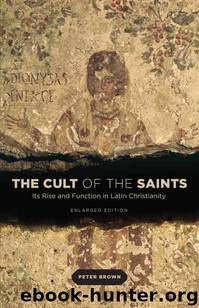
Author:Peter Brown [Brown, Peter]
Language: eng
Format: epub
Tags: History, Religion, Non-Fiction
ISBN: 9780226175263
Amazon: 022617526X
Goodreads: 198833
Publisher: University Of Chicago Press
Published: 2014-11-11T23:00:00+00:00
Chapter Five
Praesentia
In a characteristic moment of penetrating disapproval, Hegel wrote of the piety of the middle ages:
The Holy as a mere thing has the character of externality; thus it is capable of being taken possession of by another to my exclusion; it may come into an alien hand, since the process of appropriating it is not one that takes place in Spirit, but is conditioned by its quality as an external object. The highest of human blessings is in the hands of others.1
Hegel was speaking of the role of the clergy as the guardians of the Eucharist in the middle ages. But in the cult of relics also, late-antique and early-medieval piety lived down with gusto to his strictures. This cult gloried in particularity. Hic locus est: “Here is the place,” or simply hic, is a refrain that runs through the inscriptions on the early martyrs’ shrines of North Africa.2 The holy was available in one place, and in each such place it was accessible to one group in a manner in which it could not be accessible to anyone situated elsewhere.
By localizing the holy in this manner, late-antique Christianity could feed on the facts of distance and on the joys of proximity. This distance might be physical distance. For this, pilgrimage was the remedy. As Alphonse Dupront has put it, so succinctly, pilgrimage was “une thérapie par l’espace.”3 The pilgrim committed himself or herself to the “therapy of distance” by recognizing that what he or she wished for was not to be had in the immediate environment.4 Distance could symbolize needs unsatisfied, so that, as Dupront continues, “le pèlerinage demeure essentiellement départ”: pilgrimage remains essentially the act of leaving.5 But distance is there to be overcome; the experience of pilgrimage activates a yearning for intimate closeness. For the pilgrims who arrived after the obvious “therapy of distance” involved in long travel found themselves subjected to the same therapy by the nature of the shrine itself. The effect of “inverted magnitudes” sharpened the sense of distance and yearning by playing out the long delays of pilgrimage in miniature. For the art of the shrine in late antiquity is an art of closed surfaces. Behind these surfaces, the holy lay, either totally hidden or glimpsed through narrow apertures. The opacity of the surfaces heightened an awareness of the ultimate unattainability in this life of the person they had traveled over such wide spaces to touch.6
In Tebessa, the approach to the shrine, as it wound past high walls, swung under arches, crossed courtyards, and finally descended into a small half-submerged chamber, was a microcosm of the long journey of pilgrimage itself.7 At the shrine of Saint Lawrence at Rome, the first sign of patronage by a Christian emperor involved a heightening of the effect of distance; Constantine installed flights of stairs leading up and down from the grave, and “shut off” the grave itself with a grille of solid silver weighing a thousand pounds, thus keeping the tomb of Lawrence still at a short distance from the pilgrims.
Download
This site does not store any files on its server. We only index and link to content provided by other sites. Please contact the content providers to delete copyright contents if any and email us, we'll remove relevant links or contents immediately.
The Secret Power of Speaking God's Word by Joyce Meyer(3235)
Signature in the Cell: DNA and the Evidence for Intelligent Design by Stephen C. Meyer(3141)
Real Sex by Lauren F. Winner(3027)
The Holy Spirit by Billy Graham(2961)
The Gnostic Gospels by Pagels Elaine(2537)
Jesus by Paul Johnson(2366)
Devil, The by Almond Philip C(2339)
23:27 by H. L. Roberts(2255)
The Nativity by Geza Vermes(2234)
Chosen by God by R. C. Sproul(2167)
All Things New by John Eldredge(2167)
Angels of God: The Bible, the Church and the Heavenly Hosts by Mike Aquilina(1971)
The Return of the Gods by Erich von Daniken(1948)
Angels by Billy Graham(1929)
Knowing God by J.I. Packer(1861)
Jesus of Nazareth by Joseph Ratzinger(1816)
The Gnostic Gospel of St. Thomas by Tau Malachi(1800)
Evidence of the Afterlife by Jeffrey Long(1793)
How To Be Born Again by Billy Graham(1789)
